I often wait until the early hours of the morning to make recordings, but then there are the occasional outside sounds like this train in the night. Then sometimes there are birds and sometimes puppies, or then the slide of slippers in the hallway. These accidental inclusions can even become the subject of the music, simply serendipitous. Welcome to my way of thinking about music.
The strings are silk and my instrument there is a 22 string Zheng I’ve played for a few years. There are no ornaments as you might see on Guzheng. I will sometimes slip in an extra bridge or two because I need an extra tone there, and replace strings in the gamut for testing. The tuning here is probably the Ritsu scale I was exploring a couple of years back when I made this recording. Lately I have been more interested in Gamelon, but in some sense, I hear the two are related.
Ritsu scale: E F# G A B C# D
Pelog Gamelon Scale:D Eb G# A Bb C D
Slendro Scale: C D E F# G# A# C
I play improvisationally. I am capable of writing musical notation, but it seems a rather tedious thing for me to do.
I’m not as ambitious as I was 15 years ago when I played Theremin, Didjeridu and Tibetan singing bowls.
What I do is develop a theme and play it over and over again for days. Then try to shape the basic theme, rather like one might do a visual composition.
I have a very good memory for tunes, and I have always had a visual approach to music. My wife will attest to the fact that I can hear the opening notes of most music in public spaces and immediately identify it by composer and title. I see the shape of the music in my “mind’s eye” as some people say. So, I don’t write things down, but I do listen very carefully. I do use a DAW to record my work and use digital editing.
I see my own music as a series of forms that I perform on strings that I will tune in interesting ways. When I finish with a particular piece of music that I’ve recorded, I nearly try to forget what I’ve done, so I can move on to the next with a fresh approach.
Musicians interested to play flutes with a directed airflow might find my remarks helpful today concerning end-blown flutes without those details. I insist they are much more interesting because they have more expressive possibilities.
What is an end-blown flute? This is somewhat self-explanatory, but a distinction I like to make is the way air is directed over a resonant cavity. If there is a built-in passageway to direct the air, (as in Ocarina or Recorder) it makes the flute simple to play, but it does remove a large portion of the dynamics of breathing available. When the breath is directed largely by the lips and palate, and the various angles the flute is held against the mouth, the tonal qualities increase dramatically. But there is a learning curve, and to that area I would like to direct my thoughts for you, the reader.
“It’s fine that you are all deep into music. But there’s something deeper and if you would go deeper, if you go to the source of where the music is being made, you’ll find something even more interesting. At the source, everyone’s individual music is made. If you ask what the deep place is, it’s ur own life and it’s knowing your own life, that own way that you live.” —Watazumi Dōso, わたづみ どうそ) Roshi (November 20, 1911 – December 14, 1992) was a master of the end-blown Japanese bamboo flute. He studied Rinzai Zen, attaining the title of rōshi (老師).
Here are some examples of embouchures on different flutes. the bottom one is a Xun.
This is an example of an Utaguchi
Shakuhachi is a traditional Japanese end-blown flute of a specific length, but often now this length is ignored and is used generically. The notch on the end is called the Utaguchi. We can use this for reference as to how to shape your embouchure, or mouth position.
What is the ideal mouth shape and position to voice an end-blown flute?
This is a fairly standard notch or “utaguchi” for Japanese Shakuhachi
This is a fairly standard embouembouchure
Each flute will present a different set of changes to your embouchure, and to hit the higher notes will often need a slight change of position and shape. No two flutes are alike, though they may appear to be the same.
Start out by blowing very softly. Remember that you are not only perturbing the air at the top of the column, but at positions along it there are harmonic nodes from the interaction of air and shape of the vessel. Sometimes just a little air is needed to activate the whole column.
When the openings are made for your fingers along it, they change the airflow. This is how the gamut of notes are achieved. Often the changes in your lips will be needed to reach the tones you require.
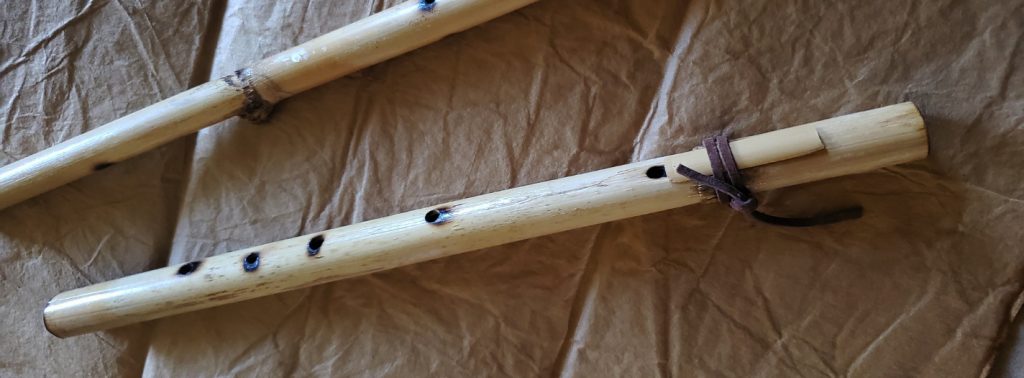
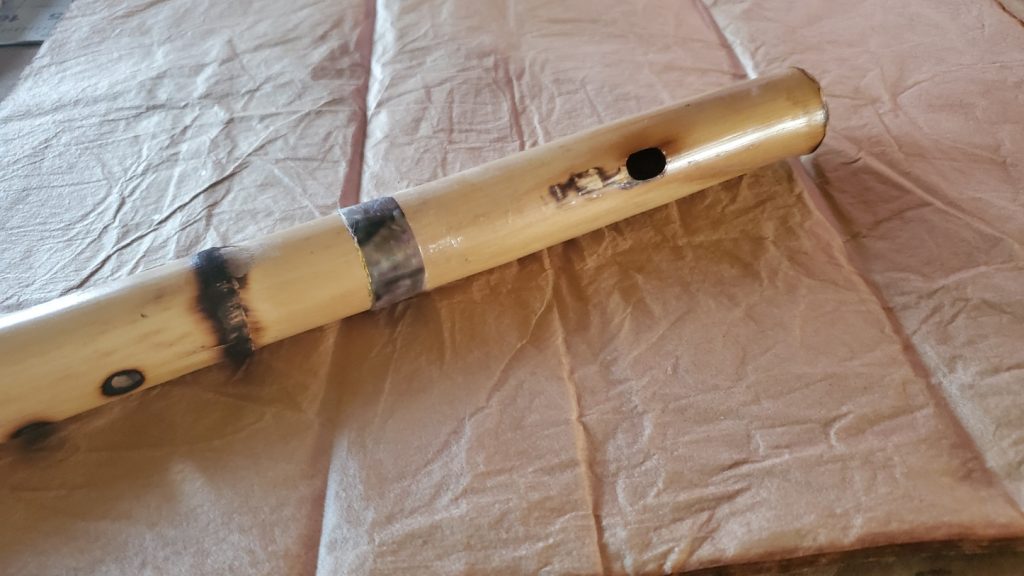
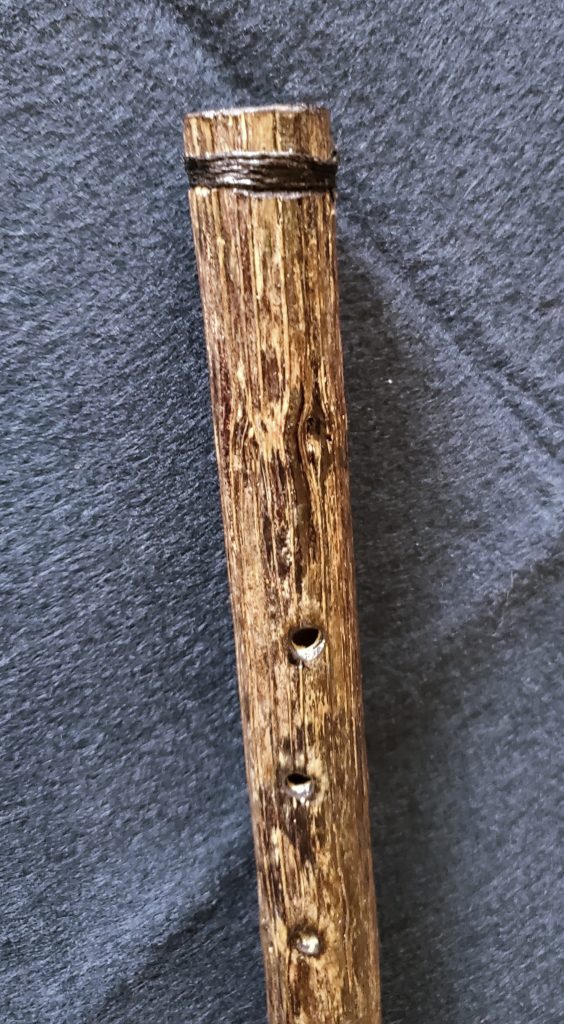
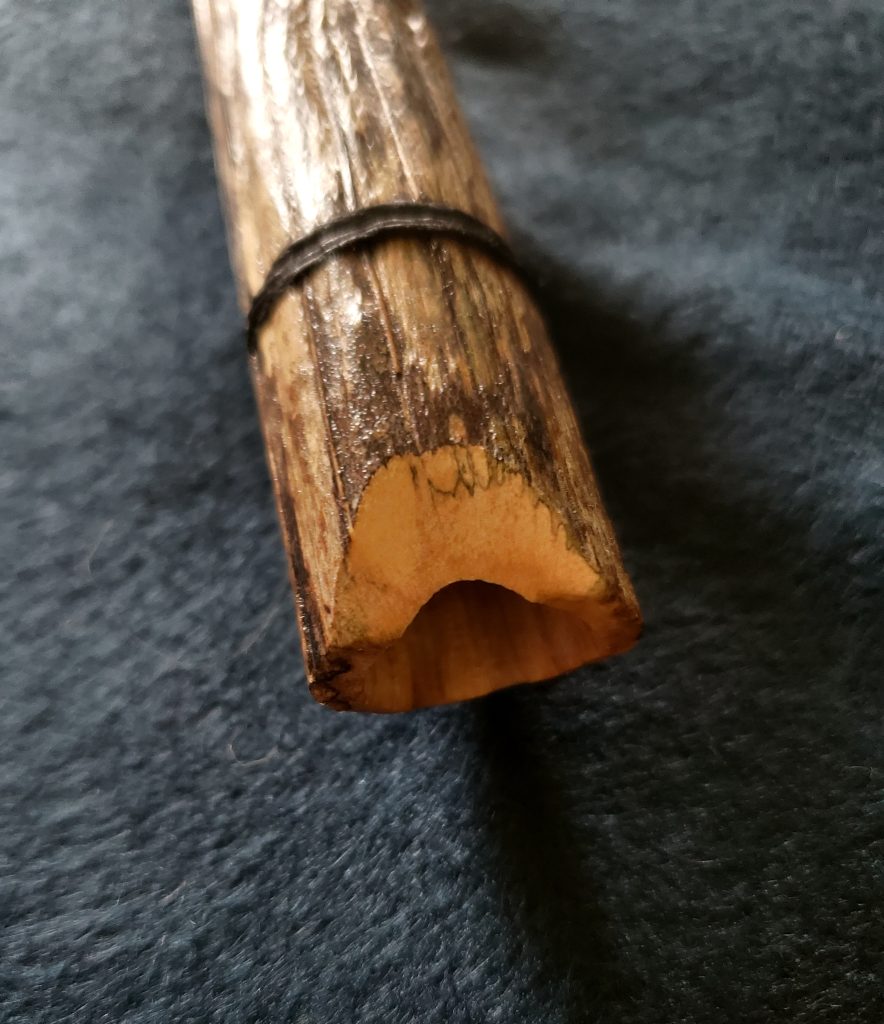
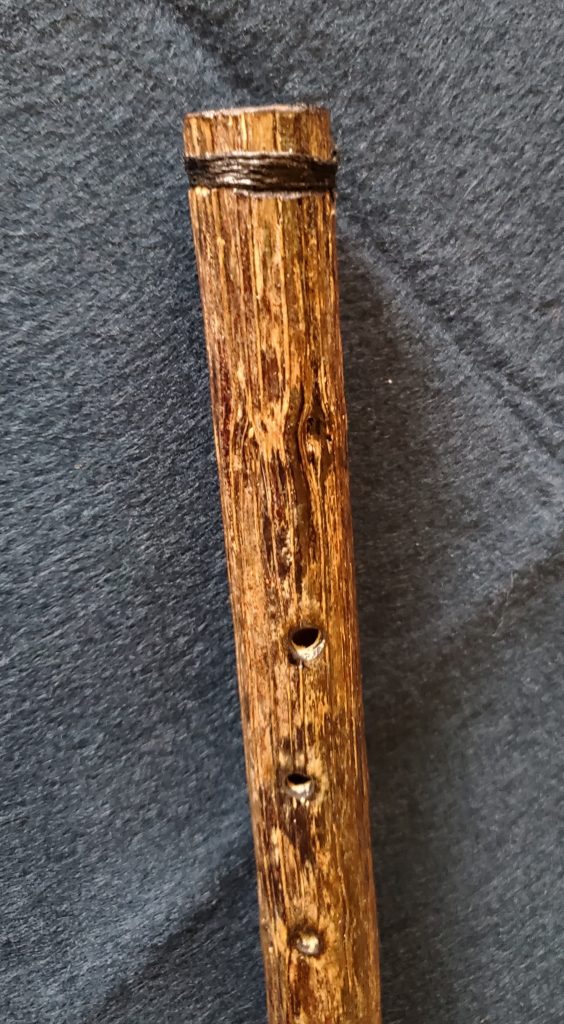
This flute is made in Arundo Donax, a type of river cane. The utaguchi is a little different, with a broader notch. The semicircular opening at the edge is also smaller. This requires a different embouchure to play it.
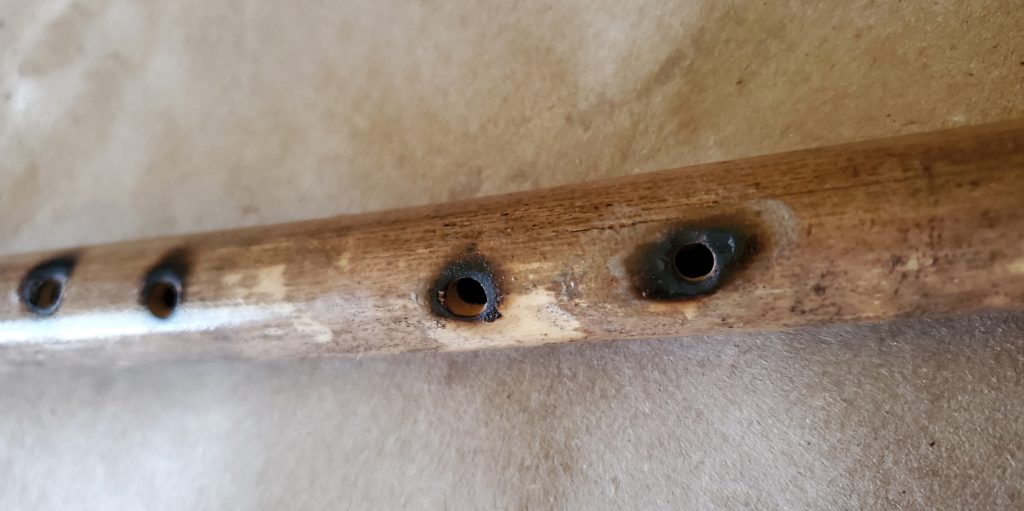
Finger holes
When you place your fingers over all the holes along the tube it becomes a simple resonant cavity. As you open each by lifting your fingers the resonance changes dynamically. Most often you might begin by opening the holes from the bottom, each in turn. But this is not always the case. Learn by experimenting that some notes are achieved by alternate opening of holes out of sequence.
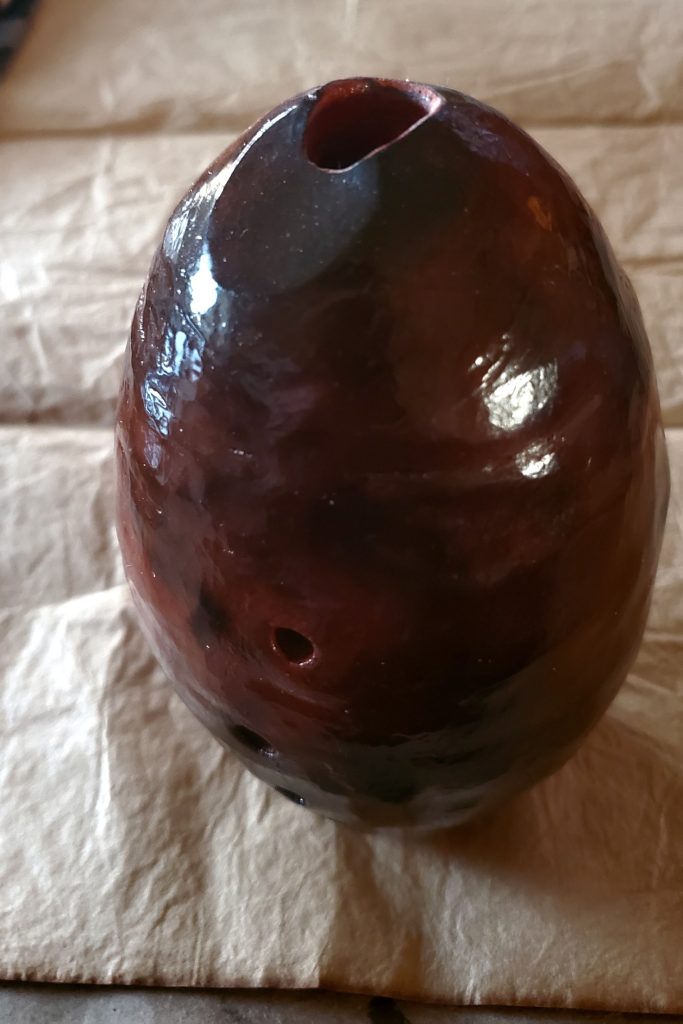
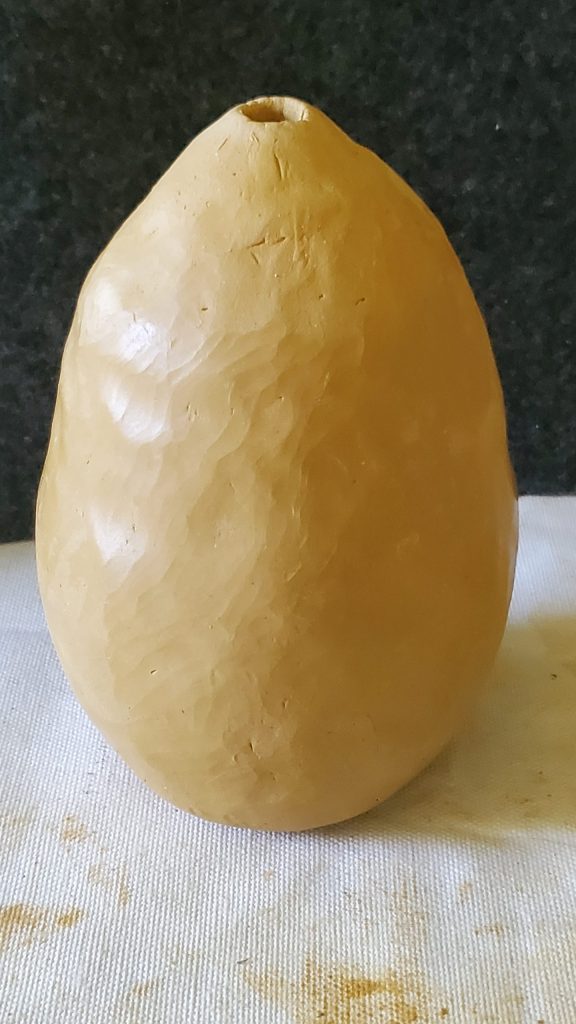
This is a ‘vessel flute’, or Xun.
Without the basic “training wheels” of an Ocarina you will need to shape your mouth correctly. Why bother? It will allow you to play much more dynamically once you learn it.
Since the vessel flute is essentially closed at the bottom, the dynamics throughout are rather different. There is a more cumulative effect overall. More open holes raises the note by amounts related to the air pressure released. There is no big opening in the bottom as in the Shakuhachi model we began with. You can change the pitch by opening more holes, somewhat at random.
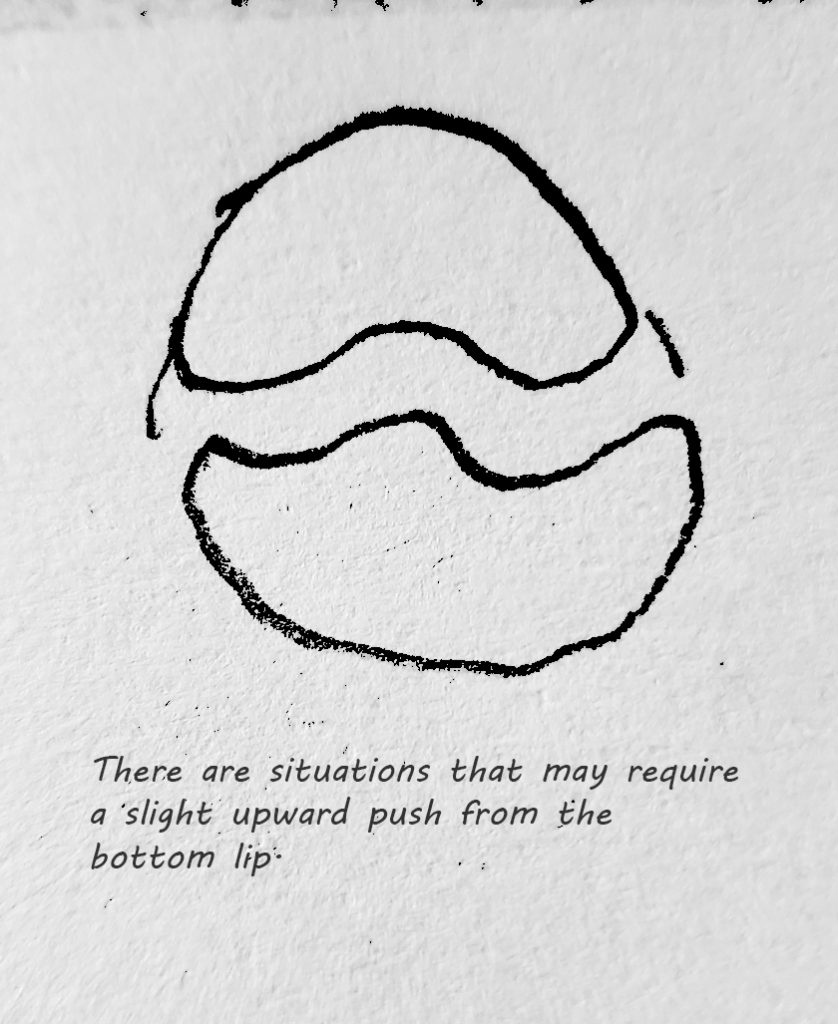
Here are some drawings to illustrate ways to shape your lips to achieve the tones you want. Learn to adjust these basic shapes for nearly any instrument you may pick up.
Remember that at certain points the opening in your lips might be more useful if they are not simply a flat oval, but the bottom lip may need to be forced a little upward.
Posted inArt|Comments Off on More About End-blown Flutes
Xun is a very ancient musical instrument, originally of clay. Is an end-blown wood Xun, a Xun in the strictest sense? Is a clay Ocarina strictly speaking a kind of Xun?
Xun is often presented as the “oldest” instrument, but several others could just as easily have that distinction, if ” first” really matters. Xun is old, old. Xun is primarily about Earth, to me, and as a potter, it becomes intriguing to make music with Earth.
Really old Bone flutes
What distinguishes a Xun from an Ocarina, to my way of thinking, is that it is an end-blown flute rather than one with a ducted airstream. A Recorder or Pennywhistle has built into it an ‘airway’ that directs the breath over the edge of a hole that “whistles”. Some refer to this edge as the ‘fipple”.
What’s going on with your breath that it makes a sound? It is the perturbation of the air as it passes over an edge, in an up-and-down manner at a frequency that causes sound. The air moves in waves made by this motion, and it causes sympathetic vibrations through the atmosphere to your ear canal. This is what you hear. It happens in your brain, due to tiny hairs in the ear that vibrate in resonance with the moving air and spark the nerve cells into action, to send a series of signals to it.
An Ocarina is a ducted flute with a fixed blowing edge, and a channel to direct the air.
This vibration of air also flows into any resonant cavity in close enough proximity so that more sounds are produced. I am speaking specifically in reference to the cavity of the attached column of air that is connected to the “whistle”. It could also be a nearby vessel that can develop harmonic vibrations to a lesser extent. All of these factors will have subtle effects on what exactly is heard. In the case of a flute, it is an open-ended air column. In the case of Xun, this is a closed resonant cavity. Either case, the musician who breathes into the air column might want to produce a variety of different tones. This is done by piercing the air column at various points. It causes different harmonics to generate in the resonating cavity or air column.
Theorists have often pointed out that he openings in a flute that change the tone are placed at mathematical intervals to lengthen or shorten the column of air, so that specific tones can be predicted mathematically. This is only a partial truth. Demonstrably, the size of the hole has as much to do with the tone as is the placement of it. I point out frequently, that either a Xun or Ocarina with holes placed in columns along the length of the resonating vessel can be tuned primarily by the size of the holes that one covers alternately to modulate the tone. A specific set of tones depend more on how much of the air is allowed to escape!
A Xun, seen to the right, has an opening that requires you to provide the correct embouchure.
A Flute, Recorder or Ocarina has a fixed system to ensure the preferred sounds are generated
On an open-ended column of air, the first note with all other holes plugged by the fingertips, is determined by the mass of air it contains and secondarily by the length. The vibration of the air column is modulated by more than one factor. So that if a hole is added to allow air to vibrate differently, it is more than one factor that determines the tone. If you place the given hole in the column at random, the tone will rise, and if the hole is expanded, that second tone is added to the primary tone and can be so adjusted. Keep in mind, also, that the entire container, ie. the ‘flute’, is also vibrating the air around it. It adds more than can be easily quantified without some very advanced monitoring equipment beyond the brain.
Another end blown flute that should be mentioned here is the
Transverse Flute, many examples of which are used in orchestras, but many simpler wooden varieties exist in many traditional cultures as well. In this example the opening is on the side of the column and also requires the musician to provide the correct embouchure with their lips.
In a closed air column, (such as either an Ocarina or Xun) the first tone generated is related to the size of the vessel, not entirely unlike the open air column of a flute. Both the air and the vessel vibrate together at the resonant frequency. (An irregular shape has some effect on this resonance, too) Add a small hole other than the vibrating orifice itself, and it will raise the tone if it is placed anywhere on the vessel. Ideally, you will place it where a finger can cover it. Expand that opening or add another and there will now be 3 tones available. If one hole is larger than the other, 4 tones become available as one or other of the holes are open. Add as many holes as you can cover with your fingers (or stop up with wax or something) and enlarge them until a full range of useful tones can be generated.
The End Blown flute has an advantage over whistles with “ducted’ air. The position and shape of the musician’s lips provides the direction of the airflow. This does make the instrument a little more difficult to learn, but it provides a flexibility to tone and resonance unavailable in Ocarina, Recorders or Pennywhistles.
What is the difference?
Here you can see the opening with a sharp edge. the embouchure of the Xun has an exaggerated flattened area for the air to pass over. This may be referred to as the “fipple” which is essentially the same as the Ocarina, except that the shape of the musician’s mouth directs the air instead of a built-in device such as seen below.
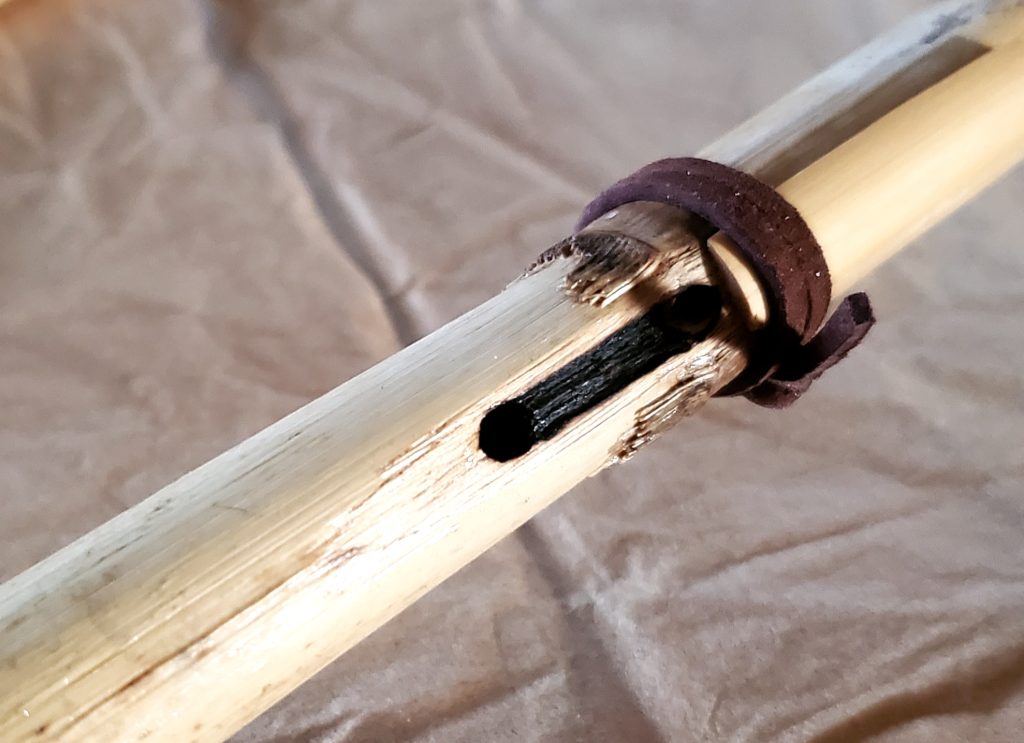
Above, you will see an opening with a little cover next to it to direct the air against the edge. It is held in place with a cord or lace so it can be slid closer or further away from it. The air is supplied from the end of the tube and redirected from another hole on the other side of a joint in the cane. This is essentially the way Native American and other tribal musicians build most of their flutes and this makes them quite simple to play. On contemporary NA flutes, a carving of a totemic animal figure is added as part of this “cover” or “block”. While it may inspire the player of the instrument, the effect on the sound itself is indirect.
Here you will see the cover slid back to reveal the little track that is burned into the surface to allow the air to transfer to the hole where the air begins to vibrate. Some will refer to this as the “sound hole” to distinguish it from the holes made to modulate the tone.
The amount of air available is carefully adjusted by the size, length and position of this track in relation to the sound hole. The placement of the little “cover” can affect the sound it creates in subtle adjustments. These delicate adjustments of airflow are provided by the shape of the lips and placement against the edge of the opening of a Xun. It is very nearly the same in many respect as for any end-blown flute.
Once these adjustments are in place, the sound produced is mostly locked in. This makes it both easier to play and also limits some of the expression. Blow a little harder or soft, punctuate the little blasts of air with the tongue or a sharp breath adds a lot. But in the case of pure end-blown flutes with the adjustments of embouchure entirely provided by the musician’s lips is an vast area to explore in the richness of tone available.
The angle, the tightness of the lips, and the direction of the air can produce tonal depth and even raise the tuning as much as the next note. Angle of the lips, the opening or tightness of your lips certainly sharpen or flatten the tone.
For the Xun, made of clay, there are a range of tonal characteristics not found within any other container. I know someone who produces Xun as well as Ocarina from wood (search for Michael Bretti). His instruments sound wonderful, and he plays them very well! But clay has its own voice with an added dimension that can’t be found any other way. Listening might be the only way to really describe what is there.
The beauty of a soft clay like Earthenware is, while vitrified and no longer susceptible to eroding in water, is still soft enough to be carved and the holes adjusted. It is like soft stone. Another characteristic is that the sound is very earthy, and not like glass. There are wonderfully low and high natural tones and overtones.
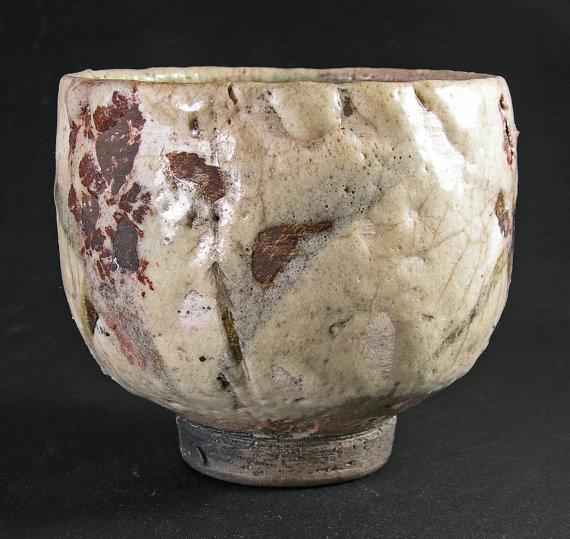
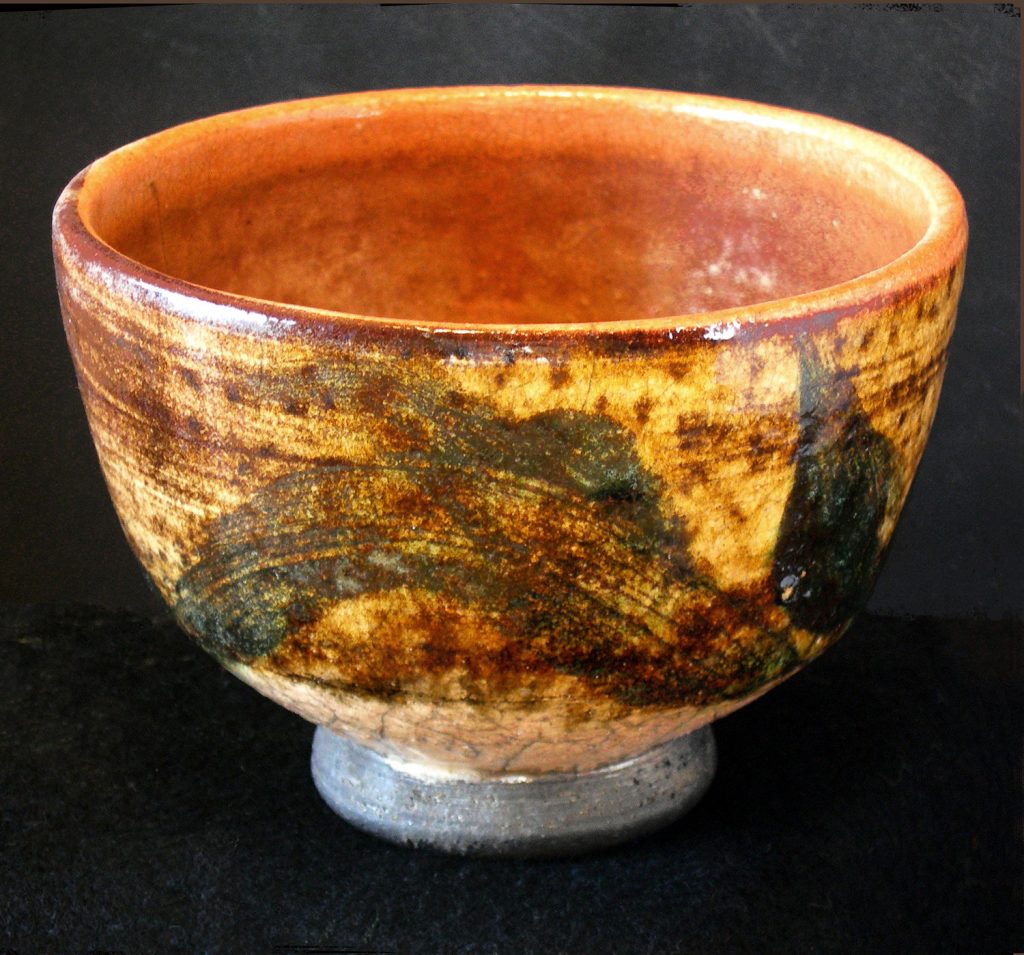
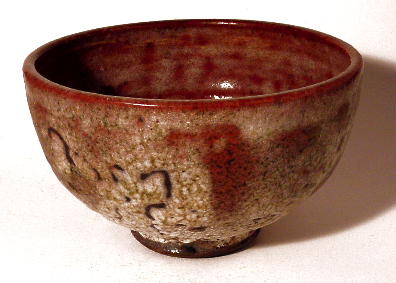
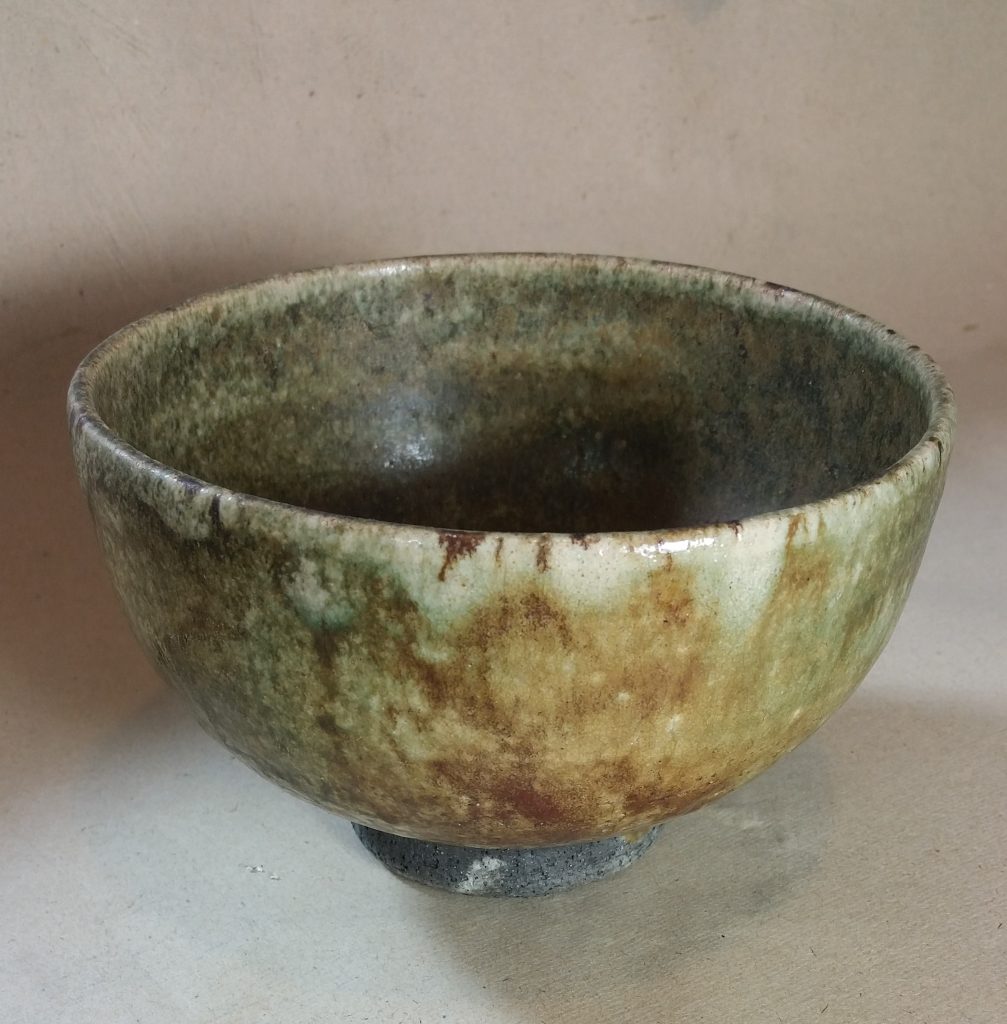
Tea bowls specifically for Matcha tea have many subtle characteristics that make them most suitable for the enjoyment of Tea. Over the last 60 years I have made and sold a variety of chawan and here are a few photos of these.
This is what I call “White Raku” ie. with a boracic glaze that appears on a white surface. I remember that in this example at the time I applied a white slip over a clay that would otherwise appear rather pink.
On this bowl I applied a red clay slip to create an orangish underglaze. The brushwork was done with a chrome oxide and burnt umber applied with a wide brush.
This is a squared bowl with green chrome oxide brushwork and a little umber pigment.
This bowl is painted entirely with a red burning clay I derived from the Oklahoma side of the Red River. The boron glaze is allowed to melt to a degree that forms bubbles and craters, and the opacity is simply due to these tiny melts in the glaze.
This bowl has the same boracic clear glaze, but it is allowed to melt until it is smooth. If left in to kiln to a greater heat, the glaze can become extremely smooth and shiny. I always preferred to remove these from the kiln at just the point that the smallest bubbles begin to form. This lends an opacity and soft white tone. This bowl is thrown with porcelain clay. Porcelain clay, due to the large particle size, actually makes a useful Raku clay. It’s actually like a heavily grogged clay of small particles and resists thermal shock. BTW I was doing this back in the early 1970s. I may have been one of the first to surmise this result.
This is a bowl with an underglaze of another glaze with copper oxide. The kiln is run with a lot of extra carbon from combustion. This allows the copper to form some dark greens instead of metallic copper, which I find to be incompatible with tea aesthetics. There are little bits of copper metal in places about the rim, which I feel acts more as an accent than an overexpression that is often expected by the uninformed when folks use the word ‘Raku’.
Posted inArt|Comments Off on Raku Chawan; Tea bowls
This recording started with an improvisation on my Zheng, tuned to Japanese Minyo scale. Then I layered it with a live recording of the tubular windbells in the photo below.
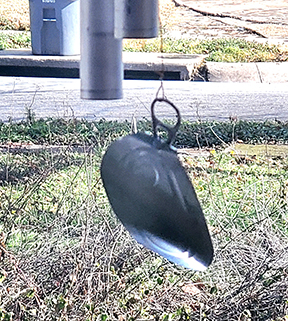
These are the windbells I have made, currently with bells tuned D4,Eb4,G#4,A4,Bb4 with an additional F#3 an octave below. I constructed it with hooks so that is is simple to replace or remove the tubular bells.
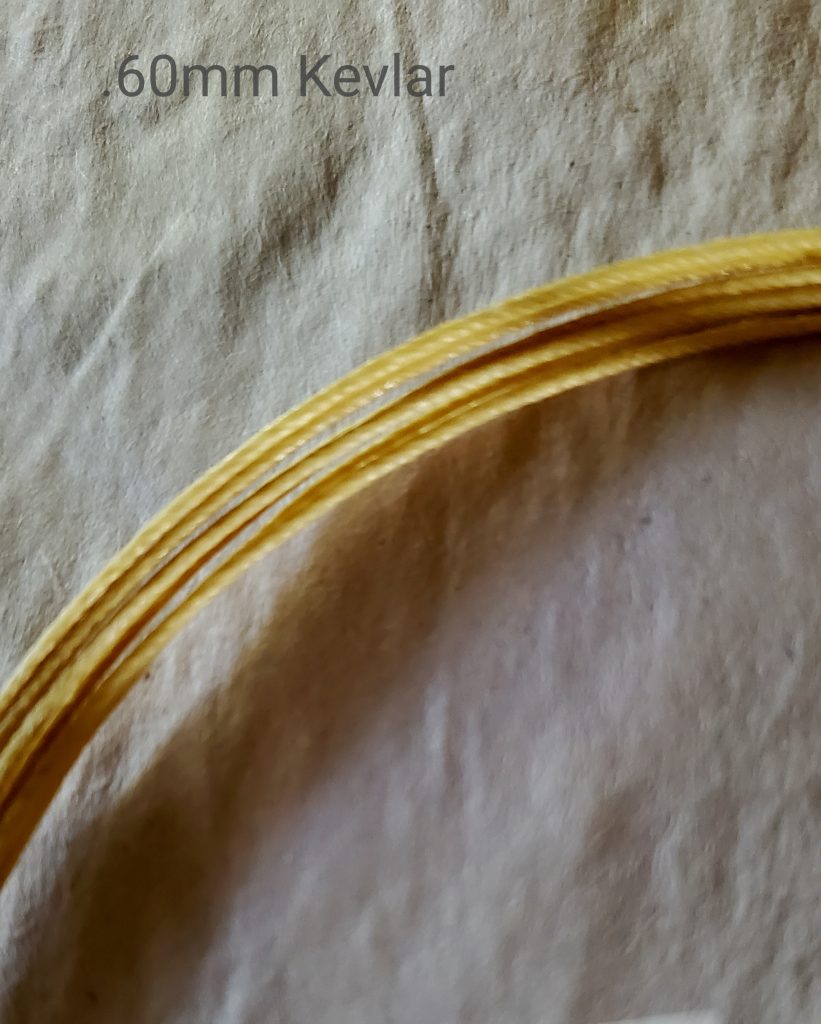
Each of the bells are suspended at the first harmonic point to allow the bell to sing at its best resonance. They are tested by holding them at various positions along the length, listening for the best resonance, and then holes are drilled and fitted with a rubber grommet. I use Kevlar cord for its resistance to abrasion. The bells are suspended below a canned chicken metal container, which I have in abundance.
The striker suspended in the center is a porcelain bead and the activator is the lid from a sardine can, twisted to act a bit like a propellor.
Posted inArt|Comments Off on Zheng Improvisation with Windbells
Here are some photos of the process of making the ancient clay musical instrument called Xun.
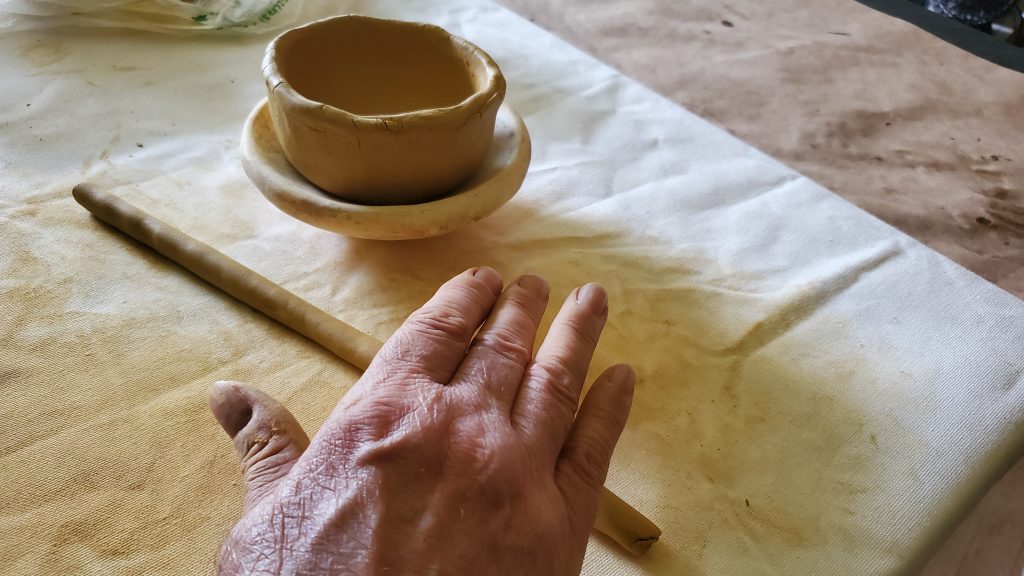
Rolling coils
Adding coils to the base
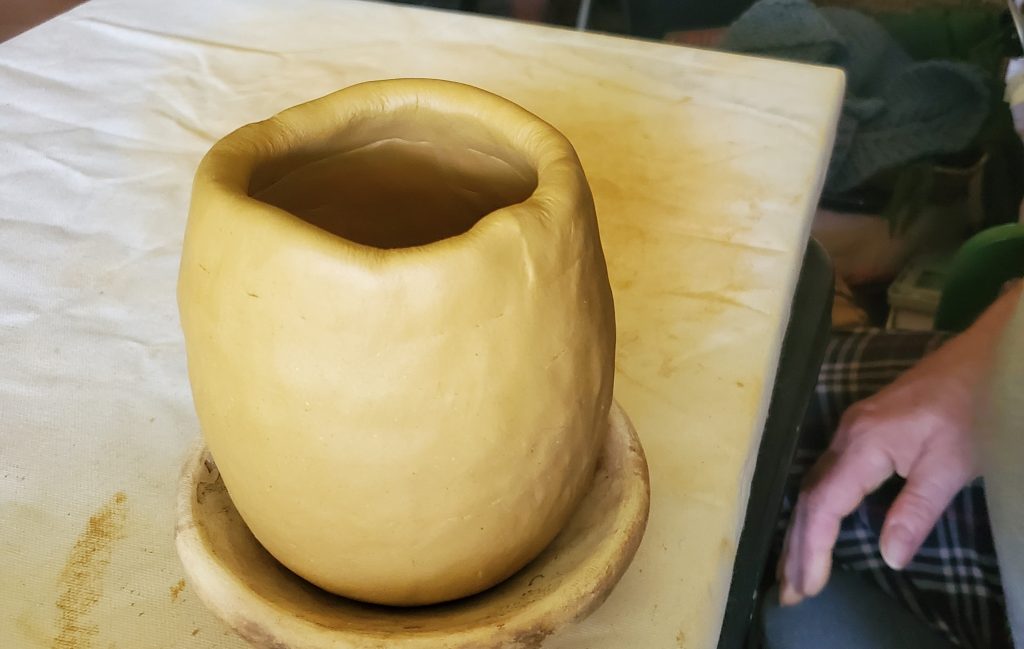
I Build up coils slowly, and form the mouth of the Xun
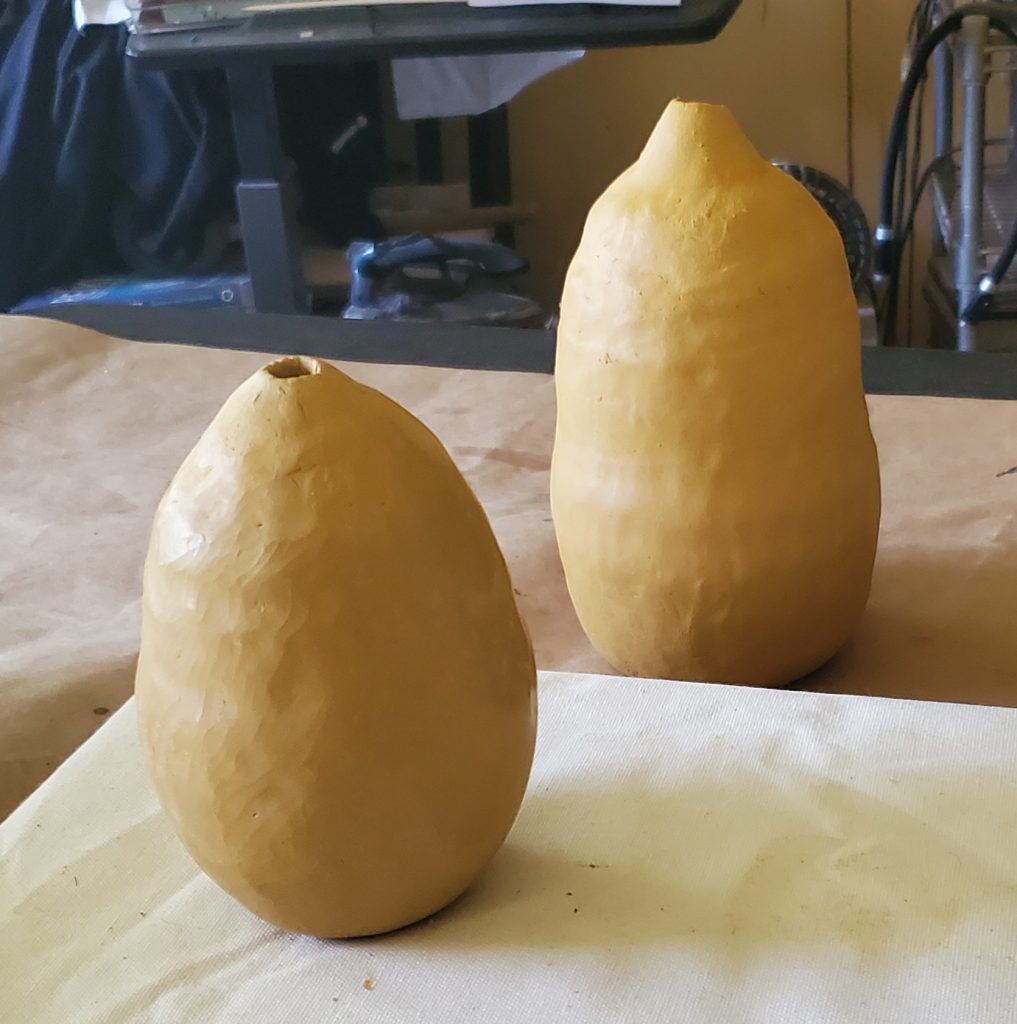
Personally, I prefer to let the surface show the slow work of my hands and fingers
Firing is an exciting process
Firing the Xun is done by simply setting up a bank of coals, then adding the pots after heating them on the perimeter to be sure they are completely dry. the next stage is to keep the heat very even and slowly raise the temperature so steam is formed very slowly. 212 degrees is the boiling point of water (212 degrees F) and at about 284 degrees F (140C) the chemically combined water begins to break free from the clay crystals. Beyond this point (at about 500 degrees F (260C) the H2O is driven completely out and the fire can progress quickly from that point. The essence of what I consider ‘Raku’ is a rapid firing that allows the potter to interact intuitively with the process. A long, slow firing is less likely to bring this level of focused attention.
The management of an open fire is a tricky thing and requires deep attention. This is where the element of air plays a role. An open fire is a very live thing. Kiln firing is simpler, of course, but a little more removed from the action, and controlled, so the results are much more predictable. Since I identify my work as ‘Raku’ the element of chance is encouraged.
After the Xun is fired, the clay is still soft enough that I can further shape the opening and refine the way it sounds. I can open the finger holes and tune it to preferred range of notes. I use lot of small files and can drill some new holes when necessary. Mostly 8 holes are quite enough; six on the front and two for your thumbs that I hardly use, myself.